
Quick Answer
Smart crypto portfolio building requires reading the waves, not chasing every swell. Focus on three core principles: diversify across large-caps (50-70%), mid-caps (20-30%), and stablecoins (10-20%), understand how different assets move together, and rebalance when allocations drift beyond target ranges. Visual tools like WaveTrader's Paddle Zones and Wipeout Zones simplify complex market signals into surf-ready cues.

November 2021: crypto's total market value surged past $3 trillion for the first time. One year later? It had crashed to around $800 billion. That's not just a dip — that's a full wipeout for anyone caught paddling in the wrong zone.
Yet here's what separates seasoned wave riders from weekend warriors: they don't try to eliminate risk completely. Smart money manages it like reading ocean swells — knowing when conditions favor paddling in and when to wait for calmer seas.
Most crypto newcomers chase individual moonshots. They hear about a coin pumping 300% and dive in headfirst, ignoring the bigger picture. But here's what the pros know: diversification works as your financial lifeline when markets turn choppy. For those just starting their crypto trading journey, understanding portfolio construction is essential before making your first trade.
A well-built portfolio cushions the impact when your favorite altcoin takes a beating. Think of it like this — when one wave crashes, others might still be building. Bitcoin's shown a correlation of just 0.53 with stocks and 0.26 with bonds, meaning it often moves independently from traditional markets.
The goal isn't perfect safety — it's intelligent wave reading. Just like surfers study ocean patterns before paddling out, smart investors build portfolios that can handle whatever the crypto seas throw at them.
Ready to build a portfolio that actually makes money? Let's paddle out and catch some profitable swells.
Key Takeaways
- Diversification is your lifeline: Spread risk across Bitcoin, Ethereum, promising altcoins, and stablecoins
- Correlation matters more than picks: Understand how assets move together during market storms
- Risk-adjusted returns beat flashy gains: Measure performance relative to volatility taken
- Regular rebalancing captures gains: Reset allocations when they drift from targets to lock in profits
- Visual tools cut through noise: Platforms like WaveTrader transform complex portfolio data into intuitive surf signals
Reading the Market Waves: Three Pillars of Profitable Crypto Portfolios
Building a crypto portfolio that actually makes money requires more than just picking tokens with cool names. Seasoned traders focus on three wave-reading fundamentals that separate profitable portfolios from weekend wipeouts.
Why smart money spreads the risk
Bitcoin's price can swing over 50% in six months. That's not a gentle wave — that's a tsunami that can flatten portfolios built around single bets.
Diversification works like having multiple boards in your quiver. When one market sector takes a beating, others might still be catching swells. Spread your investments across different digital assets, and you reduce the chances that one token's bad day ruins your entire portfolio.
The benefits flow beyond simple risk reduction:
- • Multiple growth shots across different blockchain sectors
- • Sector storm protection when regulations target specific token types
- • Better profit potential by increasing your odds of holding winners
Here's where many newcomers crash: over-diversification. Hold too many small positions and your portfolio just mirrors the market — gains and losses cancel each other out. Smart allocation looks something like this: 50% in established coins like Bitcoin and Ethereum, 30% in promising mid-caps, and the rest split between smaller projects and stablecoins.
What risk-adjusted returns actually mean
Professional wave riders don't just chase the biggest swells — they measure how much return they earn for each unit of risk taken.
The numbers tell the story: 65% of institutional investors now rank cryptocurrencies among their top five asset classes for risk-adjusted returns over the next five years. They're not just looking at percentage gains — they're evaluating performance relative to volatility.
Sharpe Ratio
Measures return per unit of total volatility. Bitcoin hit a 12-month Sharpe ratio of 2.42 in 2025, placing it among the top 100 global assets. Above 1.0 is solid, above 2.0 is strong, above 3.0 is exceptional — like rating wave quality from fun rollers to epic barrels.
Sortino Ratio
Many crypto investors prefer this because it only penalizes downside volatility — the moves that actually hurt. Up swells don't count against you here. It's like only counting wipeouts, not smooth rides.
How asset correlation shapes your profits
Correlation — how different assets dance together — determines whether your portfolio sinks or swims during market storms.
Bitcoin's correlation with stocks sits at 0.53 and just 0.26 with bonds over recent years. These moderate numbers mean crypto often marches to its own beat, providing genuine portfolio diversification when used strategically. Understanding these patterns works much like analyzing market analytics — the data tells a story if you know how to read it.
Smart portfolios exploit these relationships. Losses in one asset get offset by gains in another. Portfolios that minimize total correlation between holdings tend to reduce risk while potentially boosting returns.
But here's the catch: research shows crypto's correlations with other risk assets have been climbing. Add just a 6% crypto position to a growth portfolio and you nearly double the overall volatility.
Master these three wave-reading skills — diversification, risk-adjusted thinking, and correlation awareness — and you'll build portfolios that can ride out market turbulence while catching the profitable swells.
Choose the Right Mix of Assets
Selecting crypto assets works like choosing your position in the lineup — each spot serves a different purpose depending on wave conditions and your skill level. With the crypto market now exceeding $3.92 trillion, understanding how to distribute investments across different asset tiers is essential for catching consistent swells.
Large-cap coins: Bitcoin, Ethereum
Every solid lineup starts with the heavyweights. Bitcoin commands 58.28% market share while Ethereum holds 10.20% — together they control roughly 68% of the entire crypto ocean.
These blue-chip assets offer the steadiest rides compared to smaller tokens. Bitcoin functions as "digital gold" — a store of value that often moves independently from traditional markets. Ethereum operates more like a tech platform, powering thousands of decentralized applications across its ecosystem.
Most wave riders allocate 50-70% of their crypto holdings to these established giants. Even conservative investors might dedicate up to 4% of their total portfolio to crypto, focusing primarily on these proven performers.
Think of them as your longboard — reliable, stable, and perfect for catching the biggest sets without getting tossed around.
Mid-cap and small-cap altcoins
Mid-cap cryptos (ranked 10-50, valued between $1-10 billion) offer the sweet spot between stability and explosive growth potential. Small-caps (outside the top 50) represent emerging projects with higher risk but potentially massive rewards.
These assets often showcase cutting-edge innovation but come with serious chop. Smart allocation suggests 20-40% to mid-caps and 10-30% to small-caps, adjusted for your risk appetite. When evaluating these tokens, break signals and trading patterns can help identify promising entry points.
Consider these your performance shortboard — nimble, responsive, but requiring more skill to ride effectively.
Stablecoins for liquidity and defense
Stablecoins like USDT and USDC act as your safety net when conditions turn ugly. Although designed to hold steady at $1 rather than pump, they serve crucial functions:
- 🛡️ Quick liquidity to capitalize on sudden opportunities
- 🛡️ Safe harbor during market storms
- 🛡️ Primary trading medium across crypto platforms
Stablecoins drive roughly 80% of trading volume on major exchanges, highlighting their critical role in the ecosystem. Keeping 10-20% of your crypto stash in stables ensures you're ready to paddle in when perfect conditions appear. When comparing exchanges and their fees, stablecoin trading pairs often offer the lowest spreads.
Think of them as your rescue board — not exciting to ride, but essential when you need to get back to shore safely.
Niche assets: NFTs, memecoins, RWAs
Beyond traditional tokens, specialized assets add unique flavor to your quiver:
Real-World Assets (RWAs):
Tokenize physical items like real estate or commodities on-chain. These blend traditional asset stability with blockchain efficiency, potentially offering lower correlation with pure crypto plays.
Memecoins:
Selective small positions can capture viral momentum. Proceed carefully — most pros limit exposure to no more than 5% of crypto holdings.
NFTs:
Non-fungible tokens represent unique digital ownership. From digital art to gaming items, NFTs add uncorrelated exposure but require deep sector knowledge.
Picture your portfolio as a pyramid: large-caps forming the stable base, mid-caps and stablecoins in the middle layers, and specialized assets crowning the top. This structure captures growth potential while managing downside when the surf turns nasty.
Read the Currents: Sector Waves Move Differently
Asset types tell only half the story. Smart money also tracks what each project actually does — because when regulatory storms hit DeFi, your gaming tokens might keep riding smooth swells.
DeFi, Gaming, and Infrastructure: The Big Three Currents
DeFi Protocols:
Rebuild banking without the banks. Uniswap (UNI), Maker (MKR), and Compound (COMP) let you lend, borrow, and trade without permission. When traditional finance stumbles, these platforms often catch different waves entirely.
Gaming Tokens:
Surfing one of crypto's fastest currents. The blockchain gaming market is expanding from $4.6 billion in 2022 to $65.7 billion by 2027 — that's 70.3% annual growth. While Bitcoin might be consolidating, gaming tokens could be building their next big swell.
Infrastructure Tokens:
The ocean floor — you don't see them, but everything depends on their stability. Polygon (MATIC), Arbitrum (ARB), and Optimism (OP) make blockchains faster and cheaper. Infrastructure often moves independently from speculative plays.
Smart contract ecosystems vs. simple payment rails
Here's where many portfolios go wrong: they treat all tokens like they're the same species of fish.
Payment coins like Bitcoin or Litecoin primarily move value from point A to point B. Smart contract platforms like Ethereum build entire digital economies. They handle three jobs simultaneously: paying for network usage, facilitating exchanges, and storing value.
This difference matters because smart contract platforms often catch different economic waves than pure payment rails. When developers flock to build new apps, platform tokens benefit. When people just want to transfer money, payment coins might outperform. Recognizing these chart patterns across different sector tokens can sharpen your timing.
Spotting hidden concentration before it bites
Think you're diversified because you hold different tokens? You might be swimming in the same current without realizing it.
Many seemingly different projects share hidden connections:
- ⚠️ Multiple tokens built on the same blockchain
- ⚠️ Projects with overlapping teams or investors
- ⚠️ Assets that respond to identical market forces
Real diversification requires understanding these underwater currents. Even a small crypto allocation can multiply your portfolio's chop — adding just 6% crypto nearly doubled overall volatility in institutional simulations.
Check your sector allocations after big moves. When gaming tokens pump 200%, they might dominate your portfolio overnight. Rebalancing back to target weights captures those gains while maintaining your intended risk profile.
Hidden Concentration Risk
When seemingly diverse holdings actually move together because they share underlying dependencies — same blockchain, same investors, or same market forces. It's like thinking you're surfing different breaks when they're all fed by the same swell.
Multiple Strategies Keep You Riding Every Wave
Smart portfolio management goes beyond just holding the right tokens — you need multiple approaches working together like a complete surf kit. Each strategy serves a different purpose: some protect your downside, others capture upside, and the best ones do both.
HODLing vs. Active Trading: Know your role
Long-term HODLing
Buy and hold through storms
Buy solid projects and sit tight through the storms. Bitcoin and Ethereum holders who stuck through previous cycles often saw the biggest gains.
Active Trading
Catch smaller waves for quicker profits
Sounds appealing, but roughly 95% of day traders eventually lose money. Market volatility, fees, and emotional decisions create a perfect storm for beginners.
The smart money? Most successful crypto investors use a hybrid approach — allocate 70-80% to long-term positions while dedicating a smaller portion to trading opportunities. This gives you stability plus a chance to learn active trading without risking everything. Understanding the psychology behind market cycles helps you stick to your strategy when emotions run high.
Passive income: Let your crypto work while you sleep
Staking:
The simplest path to earning yield. Lock up tokens like Ethereum, Cardano, or Solana to support network operations and earn 3-10% APY. It's like earning dividends on stocks — steady, predictable returns with minimal effort.
Yield Farming:
More complex but potentially more rewarding. Provide liquidity to DeFi protocols and earn anywhere from 5% to over 100% annually. The catch? Higher yields usually mean higher risks through smart contract bugs or "impermanent loss."
Be aware that staking rewards have tax implications — the IRS treats them as income in most cases. Track your staking rewards carefully to avoid surprises at tax time.
Hedging: Insurance for your wave riding
Derivatives work as insurance policies for your crypto holdings. Futures, options, and perpetual swaps let you take opposite positions to protect against market crashes.
Say you hold Bitcoin but worry about a potential drop. Buy put options as insurance — if Bitcoin falls, your options gain value to offset losses in your main position. Perpetual swaps offer similar protection without expiration dates.
These tools require more knowledge, but they're powerful for protecting gains during uncertain times. If you're exploring swing trading strategies, hedging becomes even more relevant for managing open positions.
Find Your Perfect Wave Conditions
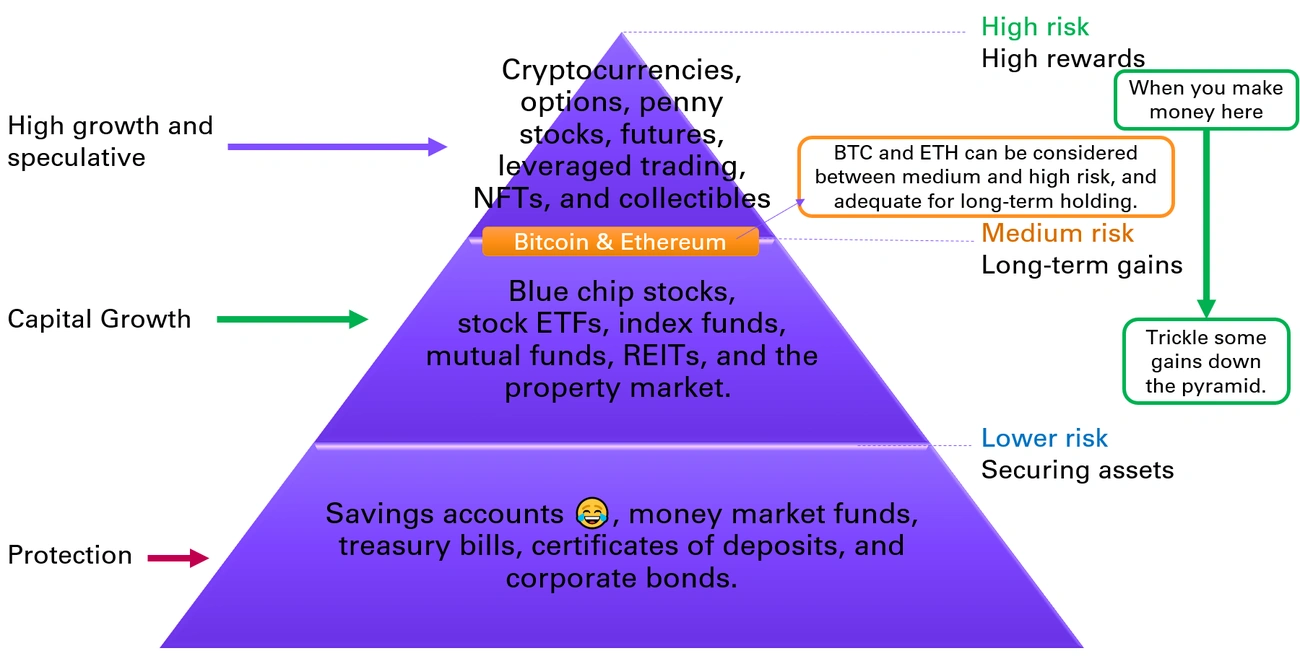 Image Source: Medium
Your risk tolerance isn't just a number — it's your surfing style. Some wave riders paddle out in hurricane swells while others prefer gentle rollers on calm days. Neither approach is wrong, but knowing which type you are determines everything about how you build your crypto portfolio.
Here's the truth most crypto guides won't tell you: there's no "perfect" portfolio allocation. What works for a 25-year-old with steady income and decades to ride out market storms will wipe out a 55-year-old approaching retirement. The key is matching your portfolio structure to your actual comfort level, not what looks good on paper.
Three waves for different riders
🌊 Calm Water Surfer
Conservative approach
Ideal for beginners and risk-averse investors. Maximum stability with proven assets.
🏄 Weekend Wave Hunter
Balanced approach
Growth potential with a safety net. Good for intermediate investors.
🌩️ Storm Chaser
Aggressive approach
Maximum upside potential with significant risk. For experienced traders only.
Quick Allocation Comparison
Conservative
60% BTC / 30% ETH / 10% Stables
Balanced
50% BTC / 25% ETH / 15% Alts / 10% Stables
Aggressive
40% BTC / 20% ETH / 25% Alts / 15% Spec
Setting your comfort zone
Most financial advisors suggest keeping crypto under 5% of your total investment portfolio. That might sound conservative, but here's why it makes sense: even that small allocation can double your portfolio's volatility. Start smaller than you think — the 1-3% range lets you sleep well while still catching meaningful upside.
Understanding how crypto market waves work helps you calibrate your comfort level over time.
When the ocean changes
Markets don't stay still. Your carefully planned 50% Bitcoin allocation might balloon to 70% after a strong run, leaving you overexposed to a single asset. Time to rebalance.
Two approaches work well:
Calendar Rebalancing
Time-based approach
Check your allocations every quarter, just like institutional investors do. Simple, disciplined, effective. Set it on your calendar and don't overthink it.
Drift Rebalancing
Threshold-based approach
Reset when any allocation moves more than 5-10% from your target. This catches big moves before they spiral out of control.
The hardest part? Actually selling your winners to buy more of what's been lagging. But that's exactly what separates profitable wave riders from those who eventually get wiped out by concentration risk. Avoiding revenge trading impulses during rebalancing is crucial — stick to your plan, not your emotions.
Smart money knows that portfolio maintenance isn't exciting — it's just necessary. Like checking your surfboard for dings before paddling out, regular rebalancing keeps you ready for whatever the crypto ocean throws your way.
Frequently Asked Questions
How much of my portfolio should be in crypto?
Most financial advisors suggest keeping crypto under 5% of your total investment portfolio. Even a small allocation can double your portfolio's overall volatility. Start with 1-3% to sleep well while still catching meaningful upside. As you gain experience reading market waves, you can gradually increase your exposure.
What is the best crypto portfolio allocation for beginners?
A conservative beginner allocation would be 60% Bitcoin, 30% Ethereum, and 10% stablecoins. This gives you exposure to the two most established cryptocurrencies while maintaining liquidity through stablecoins. As you gain experience, you can gradually introduce mid-cap altcoins and reduce the stablecoin buffer.
How often should I rebalance my crypto portfolio?
Two approaches work well: Calendar rebalancing (checking allocations every quarter) or drift rebalancing (resetting when any allocation moves more than 5-10% from your target). Calendar rebalancing is simpler and more disciplined, while drift rebalancing catches big moves before they spiral out of control.
Should I HODL or actively trade my crypto?
Most successful crypto investors use a hybrid approach: allocate 70-80% to long-term positions while dedicating a smaller portion to trading opportunities. Roughly 95% of day traders eventually lose money, so a heavy HODL strategy with selective trading gives you stability plus a chance to capture shorter-term gains.
What are risk-adjusted returns in crypto?
Risk-adjusted returns measure how much return you earn for each unit of risk taken. The Sharpe ratio measures return per unit of total volatility (above 1.0 is solid, above 2.0 is strong). The Sortino ratio only penalizes downside volatility. These metrics help you evaluate whether big gains came from skill or just taking outsized risks.
Ride Every Wave with Confidence
Smart portfolio building isn't about predicting the next moonshot — it's about reading market conditions like a seasoned surfer reads the ocean. You've learned to balance blue-chip stability with calculated risk, spot hidden correlations that trip up beginners, and use visual tools to cut through market noise.
The crypto seas will keep shifting. New sectors will emerge, regulations will evolve, and market cycles will test every strategy. But now you understand the fundamentals: diversification protects your downside, risk-adjusted returns matter more than flashy gains, and consistent rebalancing captures profits while managing exposure.
Your portfolio should reflect your appetite for volatility. Conservative wave riders stick to Bitcoin and Ethereum with stablecoin buffers. Aggressive surfers paddle into mid-caps and emerging projects. Both approaches work when matched to your timeline and temperament.
WaveTrader makes these principles actionable through visual wave patterns that replace complex spreadsheets. Blue Up Swells highlight momentum building across sectors. Orange Down Crashes warn when conditions turn choppy. Green Paddle Zones mark entry points while red Wipeout Zones signal exits — all backed by institutional-grade analytics made simple.
The market rewards patience and preparation over impulse and speculation. Whether you're staking for steady yields, trading shorter timeframes, or holding for years, success comes from applying these strategies consistently rather than chasing perfect timing.
Master the fundamentals covered here and you'll paddle out with confidence, knowing you can handle whatever the crypto ocean throws your way. The next swell is already building — are you ready to catch it?
Disclaimer: This article is for educational and informational purposes only. It does not constitute financial, investment, or trading advice. Cryptocurrency markets are volatile and carry significant risk. Past performance does not guarantee future results. Always do your own research and consider consulting a qualified financial advisor before making any investment decisions.